JAKARTA - Indonesia is the first Southeast Asian country to join BRICS. This multilateral and multipolar organization was initiated by Brazil, Russia, India, China, and later, South Africa, hereinafter referred to as BRICS. Touted as an anti-Western and anti-American policy bloc, BRICS brings a promising investment climate, particularly for the Global South. In addition to BRICS, Indonesia has also been a key partner in the Organization for Economic Co-operation and Development (OECD) since 2007 and is in the process of becoming a full member. However, the accession of Indonesia and several other ASEAN countries to other multilateral organizations has raised new concerns, namely the deprioritization of ASEAN.
In response to these concerns, the International Relations Study Program at the Indonesian Christian University (UKI) collaborated with The Habibie Center (THC) and Heinrich Böll Stiftung (HBS) Southeast Asia to hold a seminar entitled “Diversifying Engagements through BRICS and OECD: Is ASEAN Being Deprioritized?”
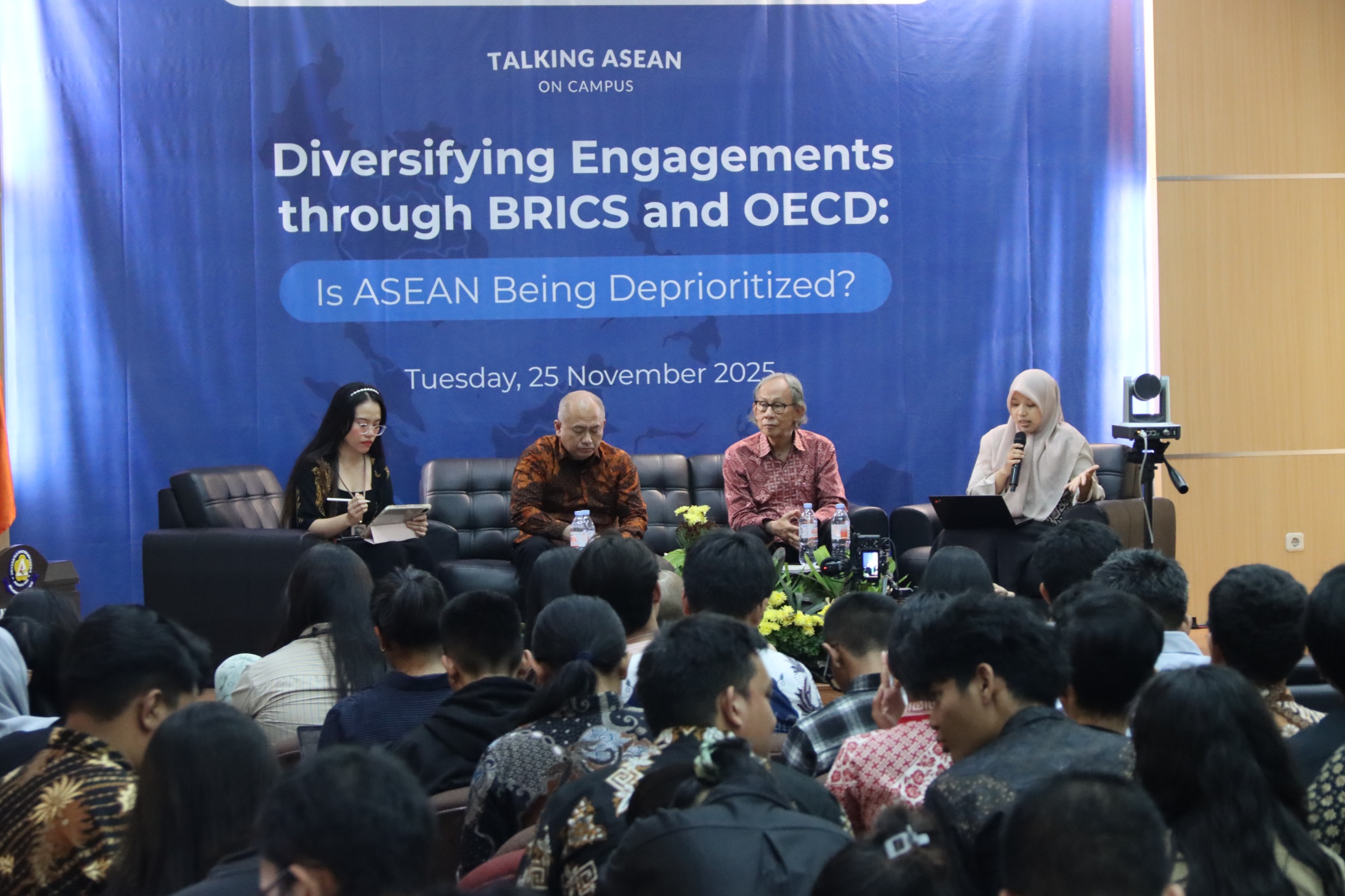
The seminar, held at the UKI Postgraduate Hall on November 25, 2025, took a sharp look at the role and influence of BRICS and the OECD in the dynamics of international relations in ASEAN. Of course, the economic and international trade aspects received serious attention in this discussion.
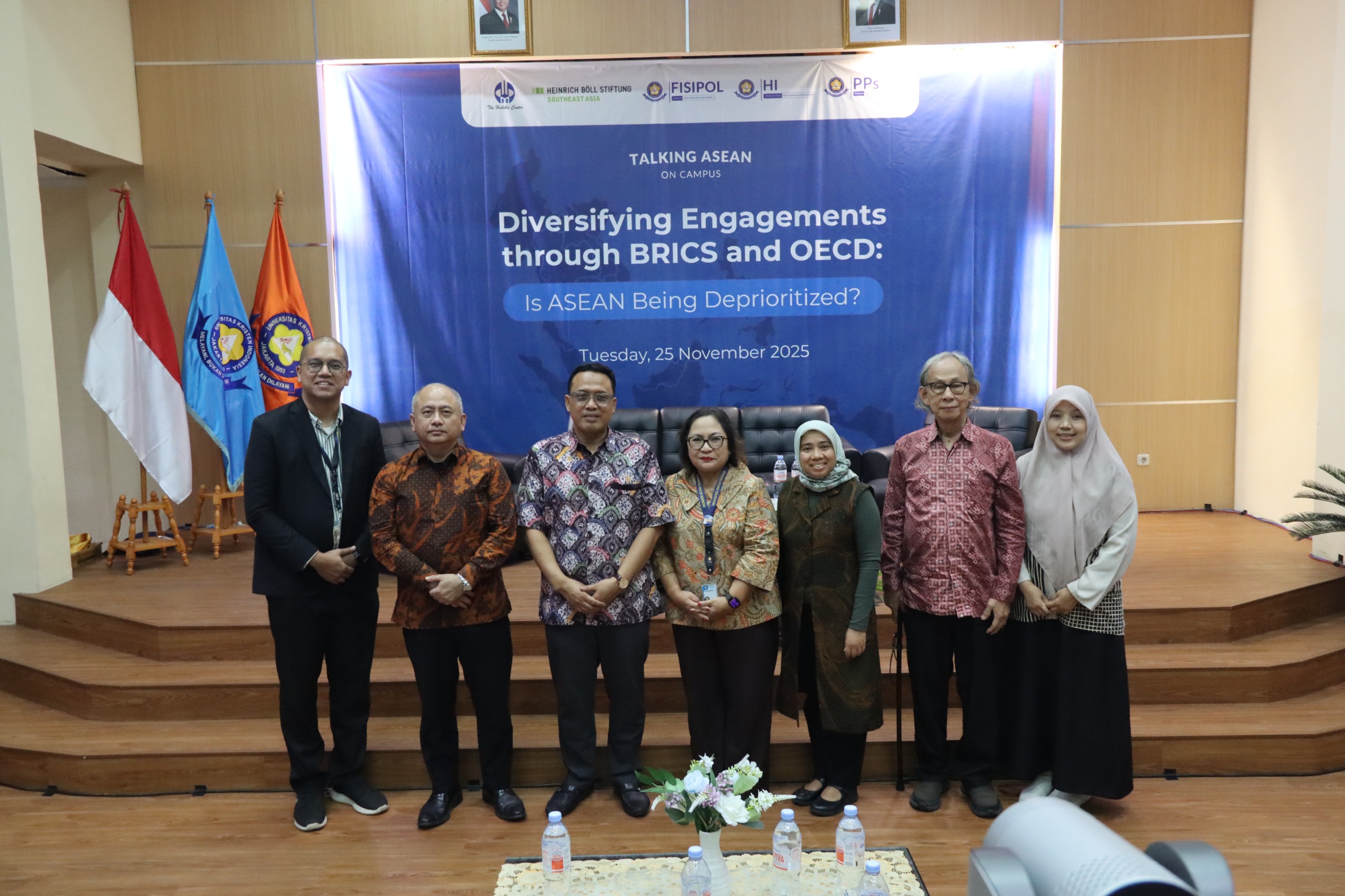
The speakers at this event were Leonard Felix Hutabarat, Ph.D. (Associate Professor at UKI and a senior diplomat in the Ministry of Foreign Affairs of the Republic of Indonesia ), Kavi Chongkittavorn (Senior Fellow, Institute of Security and International Studies, Chulalongkorn University), and Yessi Vadilla, Ph.D. (Deputy Director of Export for Mining Products, Ministry of Trade of the Republic of Indonesia). Moderated by Roihanatul Maziyah (Researcher at The Habibie Center), this discussion explored the dilemma faced by ASEAN countries in joining the two multilateral organizations, which arguably, are often contrasted with one another. This seminar was also broadcast live on THC's YouTube channel.
“This is a paradox of success: the more options we have globally, the harder it is to keep the regional house in order,” said Prof. Dr. dr. Bernadetha Nadeak, M.Pd., PA., Director of Postgraduate Studies at UKI, in her speech. Also present and giving remarks were the Dean of FISIPOL UKI, Dr. Verdinand Robertua, M.Soc. Sc., Executive Director of The Habibie Center, Dr. Mohammad Hasan Ansori, and online, Director of HBS Southeast Asia Regional Office, Marion Regina Mueller.
Darynaufal Mulyaman, S.S., M.Si. (the seminar project supervisor & assistant professor at UKI) also stated that the event marked UKI’s commitment as a research university that plays a key role in shaping regional discourse, together with THC.
Kavi Chongkittavorn, as the first speaker, explained the uniqueness of ASEAN, which cannot be replaced by other multilateral organizations. According to him, ASEAN has no external enemies. Indonesia's joining BRICS is actually beneficial to BRICS and ASEAN, because “Indonesia is a friend to all.” ASEAN countries internalize and promote the values of “Peace, Prosperity, Cooperation, and Harmony.” Therefore, Mr. Kavi disagrees with the view that ASEAN’s countries participation in BRICS and the OECD will result in the deprioritization of ASEAN. In fact, according to him, ASEAN, BRICS, and the OECD will shine even brighter.
Yessi Vadilla, a Deputy Director of Export for Mining Products at the Indonesian Ministry of Trade, presented graphs showing the economic growth of ASEAN, BRICS, and the OECD. She acknowledged that there is a risk of a “two-speed ASEAN,” where socio-economic and political disparity might widen between ASEAN Member States (AMS) that join the OECD and those that do not. She offered a solution that ASEAN must redefine “centrality,” which is no longer passive, but rather active integration. OECD standards must also be adapted in a structured manner through a convergence platform to facilitate more equitable growth among ASEAN countries. Indonesia, as one of the key members in the formation of ASEAN, must also play a bridging role between the OECD standards and ASEAN’s regional framework.
The third speaker, Assoc. Prof. Leonard Felix Hutabarat, Ph.D., said that in responding to the dynamics of BRICS-OECD-ASEAN, we must remember history, that ASEAN is our priority. It is because of ASEAN that Indonesia has been able to pursue a free and active foreign policy. Therefore, Indonesia views BRICS and the OECD as opportunities. He added that ASEAN is more than just a regional entity. ASEAN is a shared identity, and in an ever-changing world. ASEAN Centrality must be actively protected.
The discussion concluded with the conclusion that pursuing engagements with both BRICS and OECD, despite different natures and operational frameworks of these organizations, does not necessarily diminish the strategic role of another. BRICS offers a platform to amplify south-south cooperation, offers market expansion opportunities, and access to alternative financing; while the OECD brings structural reform acceleration in order to boost investor confidence, attract investments, and improve competitiveness. The dual engagement might represent a balancing act and/or strategic pragmatism by AMS aimed at mitigating vulnerabilities borne by global uncertainties while maximizing opportunities in an increasingly multipolar world.





Copyright © 2026 mnctrijaya.com
All Right Reserved


.JPG)
.JPG)
.JPG)